The American Sustainable Business Network (ASBN) recently hosted an important installment of their Continuing Conversations Webinar series, co-hosted with the Soil & Climate Alliance, “Aligning Farmers, Brands, and Policy for Scalable Regeneration.” The discussion brought together voices from the farm, the brand, and the policy world to take stock of the current state of regenerative agriculture and the long-stalled U.S. Farm Bill.
Meet the Experts
- Jessica Hulse Dillon (Moderator) — Senior Director of the Soil & Climate Alliance, Jessica works at the intersection of food and agriculture, scaling regenerative systems that prioritize soil health, biodiversity, and farmer economic wellbeing.
- Callie Eideberg — A Principal at the Vogel Group with two decades of federal agriculture and conservation policy experience, Callie has worked for the USDA and the Senate Agriculture Committee and translates complex DC policy for the private sector.
- Adam Chappell — A fourth-generation farmer from Arkansas, Adam turned to regenerative agriculture out of economic necessity. He offers a firsthand account of battling high input costs and a commodity system that often works against growers.
- Tom Gates — Global Values-Led Dairy Specialist at Ben & Jerry’s, Tom works directly with U.S. and European farmers through the brand’s “Caring Dairy” program, focusing on farm resiliency, animal welfare, and economic sustainability.
The Harsh Reality: Why “Get Bigger or Get Out” is Failing
The conversation opened with a sobering look at the economics of farming. Despite the idyllic American image of the family farm, the reality is a crisis. Adam noted that conventional farmers faced a third year of negative returns.
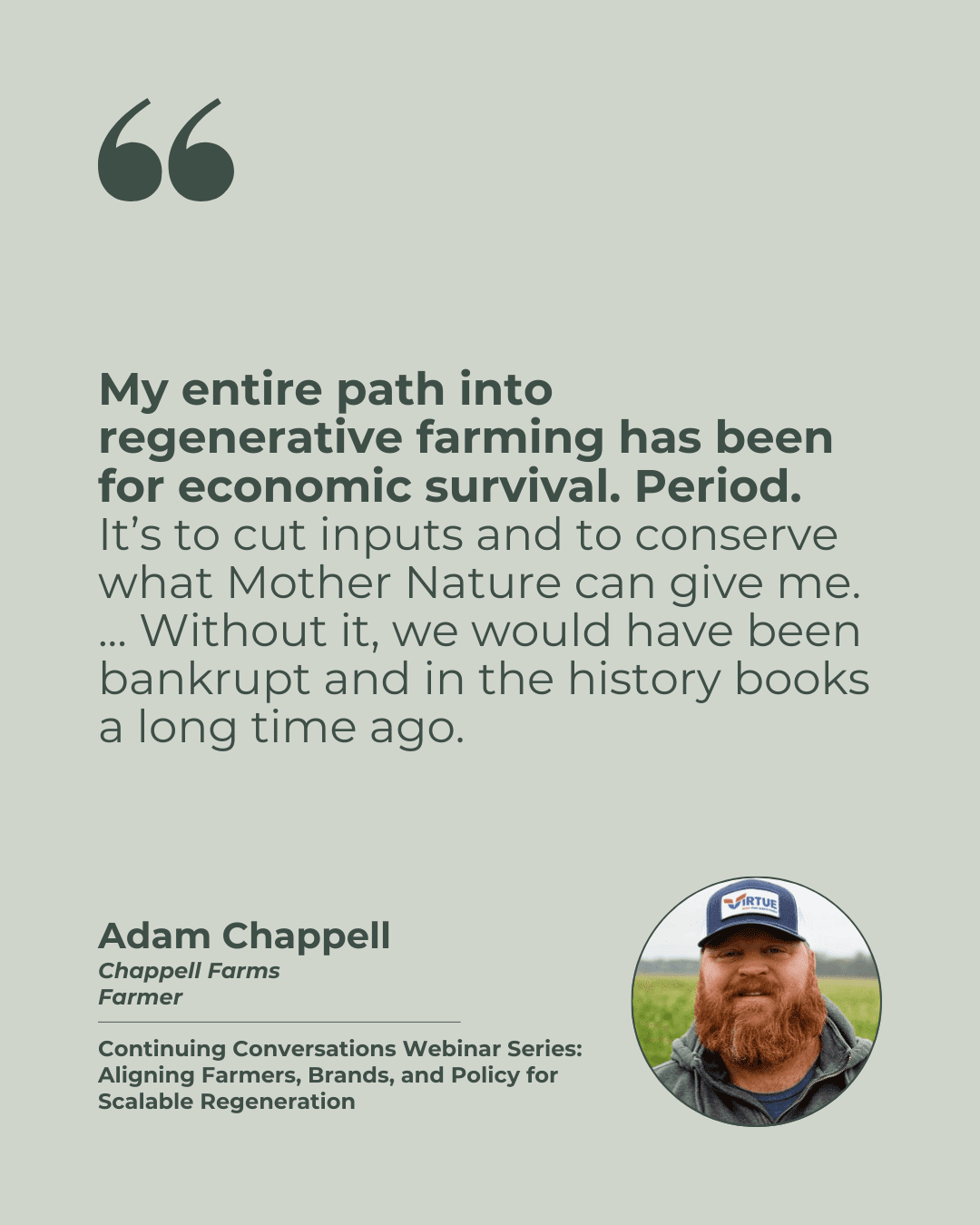 Adam explained that while input prices for seed and fertilizer remain sky-high, commodity prices are low, meaning farmers are essentially paying somebody else to plant their crops. This economic pressure is driving an aging farmer demographic (average age 64) toward retirement, with few young farmers able to enter the industry due to the high barriers to entry. The result is a consolidation of land into corporate farms and investment groups rather than families.
“Without a brighter future, those guys aren’t gonna be able to farm forever,” Adam explains, “There is no path to entry if you’re not a legacy farmer. So, if you’re a first-gen person, without help, you’re not getting in. It’s just not possible. And when that all goes over the cliff, we’re looking at corporate farms, period.”
The Farm Bill Crisis: Band-Aids on Open Wounds
A major focus of the discussion was the Farm Bill—the massive piece of legislation updated every five years that governs agricultural policy. We are currently three years overdue for a new bill.
Callie described recent government efforts, such as the $11 billion in assistance released in December, as mere “band-aids on a really big, gushing open wound.” While these funds provide temporary relief, they fail to fix systemic issues. Furthermore, when the government infuses cash into the system, input suppliers (selling chemicals and seeds) often raise their prices, absorbing the aid before it can truly help the farmer.
Adam agreed, arguing that the current subsidy system is “exactly the opposite of a safety net.” Because of payment caps, mid-to-large-scale farmers often max out their assistance quickly, while suppliers hike prices across every acre farmed, leaving the farmer in a worse financial position than before.
A Call for Antitrust Enforcement and Crop Diversification
The panel highlighted that true reform requires more than just cash payments; it requires structural change. Adam argued that antitrust laws must be enforced to break up the oligopolies controlling inputs. Currently, a handful of companies control the vast majority of fertilizer, seed, and equipment, allowing them to dictate prices to farmers.
Additionally, the group discussed the need to shift away from the 1970s mindset of “fence row to fence row” planting of corn and soy. The US currently faces a global oversupply of these commodities, yet continues to incentivize them over edible crops that could be consumed domestically.
The Role of Brands and Farm Resilience
From the brand perspective, Tom Gates highlighted how Ben & Jerry’s is trying to build resiliency on farms. Rather than just buying commodities, they encourage their dairy partners to grow more of their own feed. This practice insulates farmers from volatile market prices for feed and allows them to implement regenerative soil practices on their own land.
“Recognizing that the economics do need to work for the farm if we want to move the needle on an expansion of regen ag practices, there needs to be brand investment,” says Tom. “ And I think that that’s something that’s super critical for any brand.”
Take Action: How You Can Support Regenerative Agriculture Policy
The consensus was clear: the system is broken, and a “skinny Farm Bill” that simply extends current policies won’t fix it. Callie emphasized that in Washington, “the squeaky wheel gets the grease”. She urged citizens to contact their representatives—not just about reference prices, but about regenerative practices and systemic reform.
As Adam put it, without public pressure and policy change, the current trajectory will just continue “down this drain”.
The post From the Field to the Capitol: How the Farm Bill and Regenerative Agriculture Are Shaping the Fight for U.S. Farm Survival appeared first on American Sustainable Business Network.