

Section 401 of the Clean Water Act is under threat — and the clock is ticking. The EPA has opened a public comment period on a new proposed rule that would dramatically curtail the authority of states and federally recognized Tribes to protect local water quality. If finalized, this rule would allow federal projects — hydroelectric facilities, interstate oil and gas pipelines, and major dredge-and-fill infrastructure — to move forward without meaningful state or Tribal review. And unlike past rollbacks driven by industry lobbying, this one doesn’t even have broad support from big polluters. That should tell you something.
→ Ready to take action? Submit your business comment to the EPA & sign the collective business statement.
What Is Section 401 of the Clean Water Act — and Why Does It Matter?
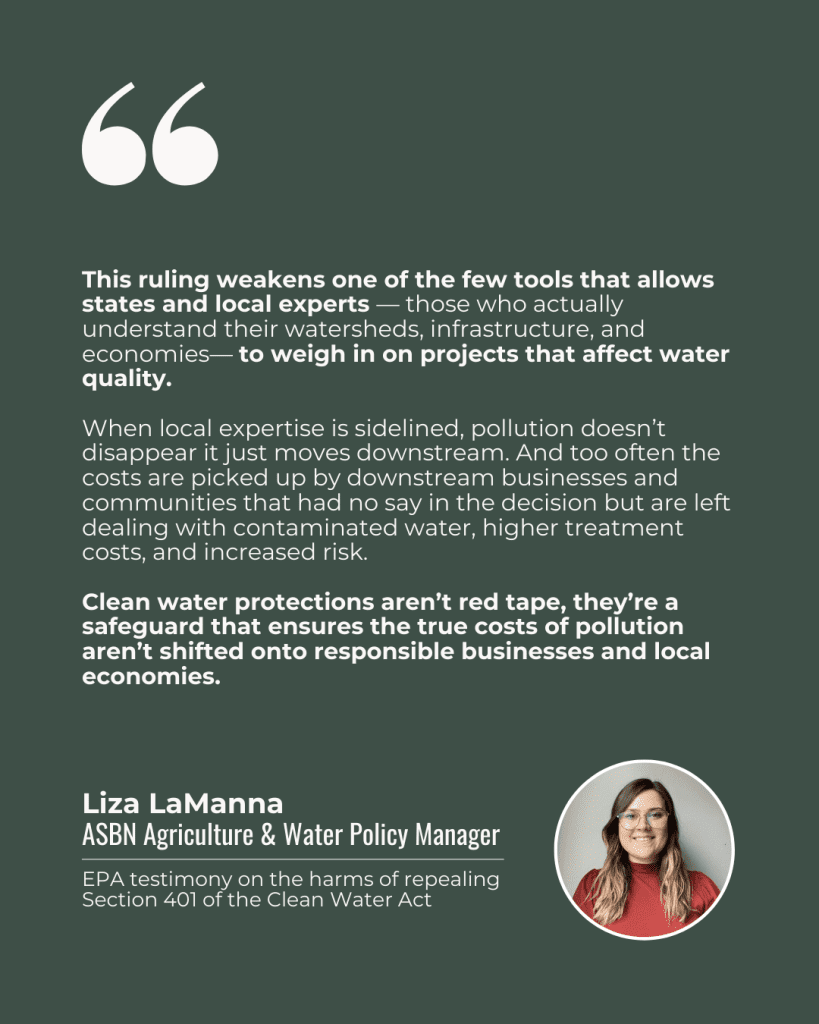 Section 401 of the Clean Water Act gives states and federally recognized Tribes the authority to review and impose protective conditions on federal permits for projects that may affect water quality. It’s a cornerstone of local oversight, allowing communities to protect drinking water, fisheries, wetlands, and the jobs and economies that depend on healthy ecosystems. The EPA’s proposed rule would narrow that authority, limiting the scope of review, constraining the conditions states and Tribes can place on projects, and imposing rigid timelines that make thorough evaluation more difficult. In practice, it shifts decision-making power away from states and Tribes and toward federal agencies, raising serious concerns about states’ rights, local control, and Tribal sovereignty.
Unlike past changes driven by pressure from big polluters for faster permitting, this proposal does not reflect a broad public demand for reform. It is a top-down action that weakens one of the Clean Water Act’s most important safeguards — with little justification and less transparency.
Short & Rushed: EPA’s Compressed Public Comment Timeline
The way the EPA structured public feedback collection makes the overreach even more obvious. The agency gave only 30 days for public comments — half the standard comment period — and initially scheduled only two back-to-back hearings. They added a third hearing at the last minute, with only five days’ notice. As ASBN’s Agriculture & Clean Water Manager, I had to “request to speak,” and even then, only eight people registered to testify during the first three-hour session — all opposing the proposed rule. By contrast, last year, there were nine listening sessions on whether the EPA should redefine the Waters of the United States. At my small business session, 30 businesses attended — not one supported strengthening water protections.
What ASBN Heard at the EPA Hearing
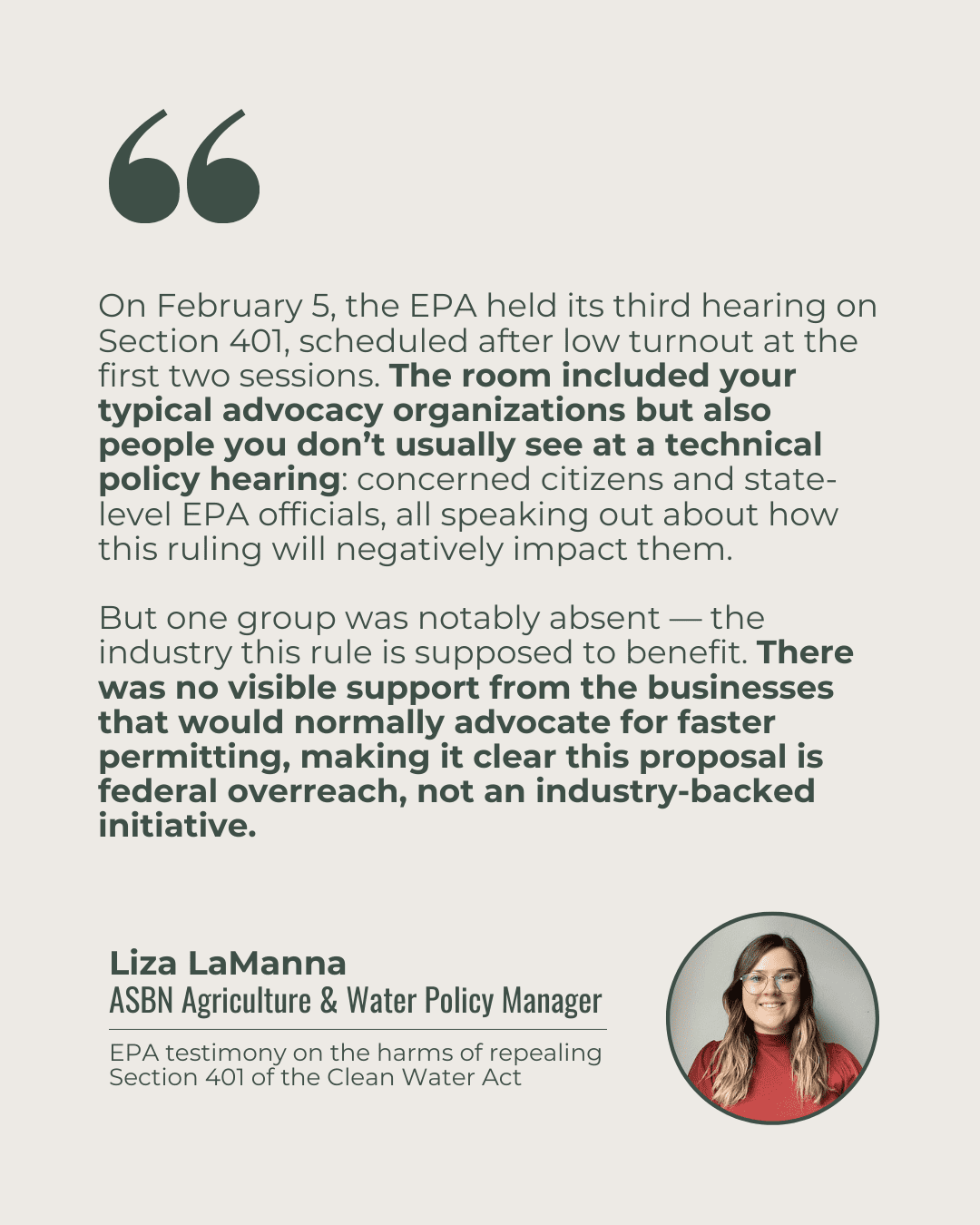 One of the rewarding parts of my job is testifying at EPA hearings, often at dedicated business stakeholder sessions, so I’m not surprised when I’m the only person in the room supporting stronger regulations. (P.S., if you ever want to join me, I would love some company. Fill out this form to let me know you are interested!) But this time, the lack of opposition to stronger regulation was stark. The public critical mass for water protection is there — we just need to make sure it is heard.
Take Action Now: Protect State, Tribal, and Community Authority Over Clean Water
We cannot allow federal overreach to quietly erode state and Tribal authority over water quality decisions. The public comment period is short, but each comment matters. Flooding the EPA docket with opposition is the best way to hold the line and show that states, Tribes, communities, and businesses are united in defending local authority over clean water.
Comment on “Updating the Water Quality Certification Regulations Docket No EPA-HQ-OW-2025-2929-0001” using our template here by 5 PM today.
Submit your business comment to the EPA & sign the collective business statement.
###
American Sustainable Business Network (ASBN) amplifies the collective voice of sustainable business to lead the way to a regenerative economy that is stakeholder-driven, just, and prosperous. As a multi-issue, membership organization advocating on behalf of every business sector, size, and geography, ASBN works to advance its mission to inform, connect, and mobilize sustainable business leaders, transforming the public and private sectors toward a just and regenerative economy.
The post Prevent Federal Overreach on Clean Water: Defend State and Tribal Rights Under Section 401 appeared first on American Sustainable Business Network.