Small Business Strategy for 2026 Midterms: Building Political Power Amid Economic Challenges
Author: Abby Maxwell
Editor: Anayana White
As we kick off 2026, this country and the business leaders who represent their communities face chaos and serious threats to business operations that demand a shift from reactive defense to proactive leadership. Small businesses nationwide are confronting challenges that require coordinated policy engagement and advocacy.
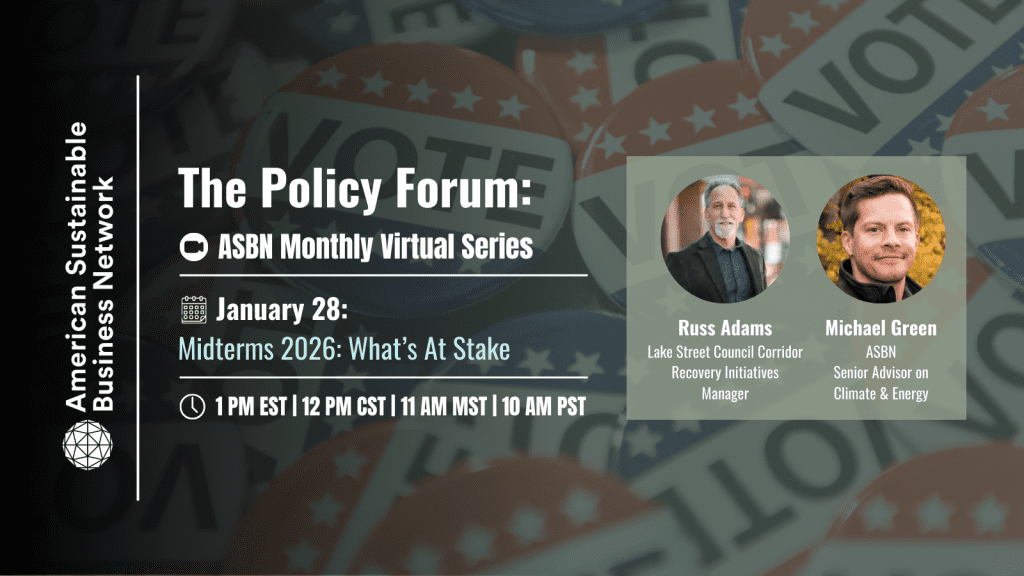
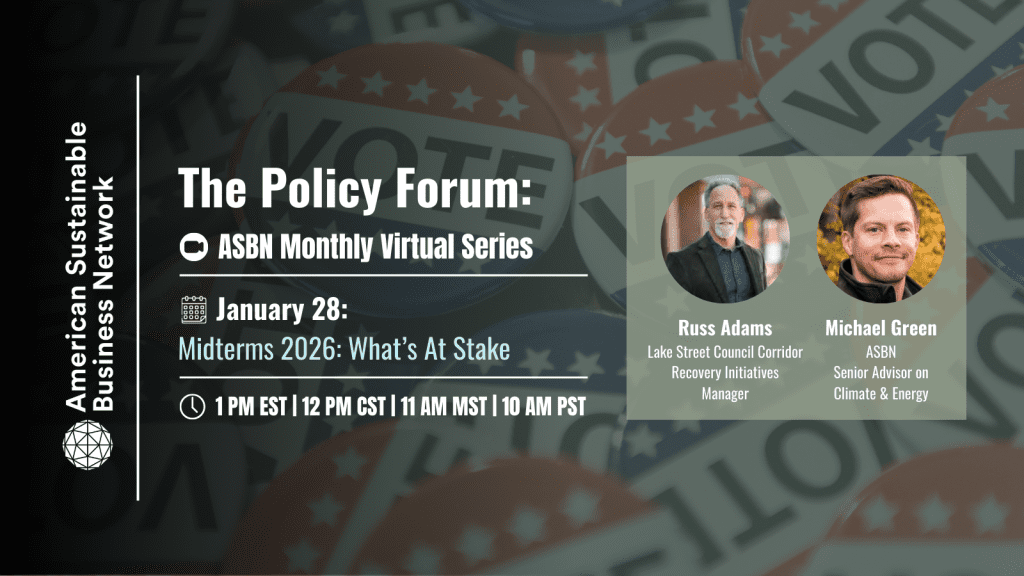
In the first webinar of the year of the Policy Forum Series, the American Sustainable Business Network (ASBN) welcomed Russ Adams, Corridor Recovery Initiatives Manager at the Lake Street Council to join Michael Green, ASBN Senior Policy Advisor to highlight the devastating on-the-ground reality for small businesses in Minneapolis and outline the beginning steps of a comprehensive strategy to build political power ahead of the midterm elections.
→ Ready to take action? Sign ASBN’s 2026 Business Pledge to commit to voting, mobilizing others, and supporting pro-business policies.
Small Business Challenges in 2026: Economic Devastation on Lake Street
Russ Adams of the Lake Street Council provided a sobering look at the “Metro Surge,” a federal immigration enforcement action that began in late 2025. While the Lake Street corridor—home to over 1,600 businesses generating $3.9 billion in annual sales—had successfully rallied to raise $12 million following the civil unrest of 2020, it now faces an existential threat from the federal government.
Russ explains that “It’s not an exaggeration to say that folks feel like they’re under siege, and our businesses feel that way too.
The heavy-handed federal presence has created a climate of fear, resulting in:
- Massive Revenue Losses: Businesses reported revenue drops of 40% in December and 50–80% in January.
- Business Closures: On any given day, nearly half of the businesses on the 6-mile corridor are closed because employees, fearing traffic stops and family separations, do not feel safe coming to work.
- Community Response: While local philanthropic and mutual aid networks have mobilized to fill the gaps, the aggressive federal policy has severely damaged the local economy.
Read more about resources for Minneapolis here.
The Pivot: Mobilizing Business Voice for Policy Engagement
ASBN’s Michael Green emphasized that the situation in Minneapolis is not isolated; small businesses across the country are facing an onslaught of anti-business, anti-environment, and anti-democracy actions.
However, Green argued that the sustainable business community can no longer afford to simply react to the “chaos carousel” of the current administration. Instead of accepting the disruptions, businesses must recognize themselves as the essential fabric of the community and use their voices to influence.
“The definition of leadership is the ability to provide direction in a time of uncertainty,” says Michael. “How are we providing direction in a time of uncertainty? Are we going to show a vision, show a future that we believe in? That is the only way that we can show leadership, especially at this point.”
Pro-Business Agenda for 2026: A Strategic Framework for Small Business Advocacy
To counter the current narrative and defend democratic principles, ASBN is launching a Pro-Business Agenda for the 2026 Midterms. This initiative aims to build political power and starts with a core framing of the business agenda around three values that are key to business survival and success:
Security: The ability to operate, work, invest, and speak honestly without constant fear of disruption or harm. Where physical safety, public health, and food security are prioritized for a successful business and community.
This goes beyond traditional definitions to include economic stability and protection against supply chain disruptions and the physical insecurity currently seen in Minneapolis.
Affordability: A country where you can afford to run a business. Where housing, healthcare, energy, insurance, and infrastructure are not priced out of reach.
The focus is on the real costs of doing business and living, ensuring that policy doesn’t just favor large corporate interests.
Opportunity: The stability and long-term thinking required for sustainable businesses to exist and grow. Where we invest in the future, and in the transition to get there.
ASBN rejects the administration’s definition of opportunity as deregulation for polluters. Instead, they champion inclusive growth and workforce development that allows all entrepreneurs to thrive.
The umbrella under which all of these ideas stand is Democracy. Fairness, Accountability, and Transparency. These are essential to a business and community’s ability to exist and thrive.
Moving Forward: Take Action for Small Business Political Power
Supporting these values is fundamentally about supporting democracy. ASBN is mobilizing the business community to participate in the Midterms.
The first action that all business leaders can take is to sign on to ASBN’s 2026 Pledge. To pledge that you will vote in the Midterms, encourage others to vote, and use the above framework to build a swell of support for the policies that will create an environment that is compatible with business success.
ASBN will be with you at each step of the process, providing toolkits and resources and answering any questions you may have.
American Sustainable Business Network (ASBN) amplifies the collective voice of sustainable business to lead the way to a regenerative economy that is stakeholder-driven, just, and prosperous. As a multi-issue, membership organization advocating on behalf of every business sector, size, and geography, ASBN works to advance its mission to inform, connect, and mobilize sustainable business leaders, transforming the public and private sectors toward a just and regenerative economy.
The post Small Business Strategy for 2026 Midterms: Building Political Power Amid Economic Challenges appeared first on American Sustainable Business Network.